
A B.R.A.G. Medallion Honoree
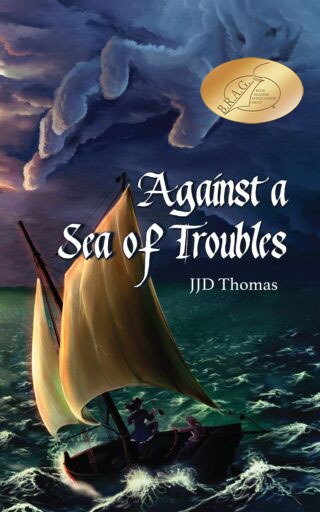
Against a Sea of Troubles is a Historical Fantasy Novel, set in the Caribbean in the Golden Age of Piracy. Mariah is a bookbinder’s daughter who seems destined for a sad, boring life as the betrothed of an old man in 18th century Jamaica. However, on her way over from England, Mariah’s boat stumbles upon a pirate captive, Toussaint “Bad Weather” Dupuis, who has a reputation for disastrously bad luck. Toussaint inspires Mariah to embrace a life on the sea, and together they embark upon a series of adventures across the Caribbean. They will fight for their freedom as pirates against forces of oppression, but how long can they sail ahead of hurricanes before the stubborn god of storms succeeds in collecting the debt Toussaint owes it?
Sample Below:
One for Sorrow
When the pirate known as “Bad Weather” was loaded onto the Triton, I did not at first give him a thought. I was lost in my own melancholy: staring out at the sea, with one arm draped over the rail, fingers stretched down to catch stray drops as they leapt from sapphire surf. We were to take the pirate to Port Royal, where he would face justice at the end of a rope, but as I also considered myself to be heading towards the end of my life, I did not spare him my sympathy. This is the nature of melancholy. I felt the fate of my unhappy marriage as heavy on my shoulders as a set of stocks, and that weight pressed down my head onto my arm onto the side of the boat. I felt such a cold, hollow sorrow in my heart as I wondered why it was that I was alive at all, and how much silence and cold, boring nothingness awaited me in this new world. I was sad, but as this is a story of pirates, let us not dwell on it.
The port officers of Antigua had a somber cloud of guilt about them when they loaded Bad Weather onto our ship. The pirate, known by some as Toussaint Dupuis, had a horrible reputation for bad luck. It was said that to go to sea with him was the same as pointing one’s bow into a tempest. The officers suspected that whichever unlucky vessel was meant to take the pirate to his hanging would be swallowed up by the sea long before it arrived, and their guilt made them confess this news before leaving us. Bad Weather himself corroborated these stories, with much self-effacing, and in such a matter-of-fact, good-natured way as to say, this is my lot in life and I’ve accepted it.
Having a bad omen on board set the men to bickering. Sailors are a superstitious lot by nature; it doesn’t matter how many things go right on a voyage, for one hole in a hull will sink the ship. They tried to reassure each other, saying that it was only a short journey to Jamaica, and besides, if this Frenchman was going to his hanging, then wouldn’t it be bad luck for him if the journey went well? And this last argument received many nods and hearty clappings of backs, but, even so, a persistent aura of unease haunted this leg of the voyage, and many eyes kept shooting upwards to the sky to see whether the weather seemed likely to turn sour.
Bad Weather himself was in high spirits. There was no place on our heavily laden merchant vessel to store a captive, so the captain secured him to the forward mast to keep an eye on him. There, the pirate attempted to make conversation with the crew, without much success. I could see him from my post in the back, always smiling and laughing at his own jokes, trying to make the stony-faced sailors crack. He found little purchase in those around him, but I, on the other hand, was already a little charmed from afar.
Even in my melancholy (which was pervasive, and quite dampened my soul), I found myself sickened with curiosity about the young pirate. How was someone with such an ugly reputation, and on such an ill-fated journey, still in high spirits? Besides, he was far too beautiful to be a pirate. He wore his hair in a thick, black mane, which the wind and seawater only ever seemed to thicken with waves, and though his chin was clean-shaven, his eyebrows were as sharp and finely plucked as those of a French madame. On the second day he was with us, I took my ocean-staring down to his side of the ship in order to better hear him talk. If I’m being honest, I watched him more than was proper for a woman engaged, but as I was soon to be married off to a stranger twice my age and forever locked inside a lonely hermitage, then right now was the time to bear the risk of being a little immodest.
“What do you think of?” he asked me, “When you’re looking out at the ocean?”
My heart jumped up into my throat. I hadn’t spoken to him. At that moment, I was simply doing my best not to stare, and, in truth, what I was thinking about was him.
“Nothing at all,” I answered without looking up from the sea.
“Oh, come now, mademoiselle,” he teased, his French accent buzzing. “You think I’ll believe you to be thoughtless? I can see something moving under your eyes. It appears to me to be a great tragedy at work.” The man’s accent was French, but he spoke English with great fluency. “Come, share your tragedy with me. We can commiserate. You know that I’m in for one myself.”
I didn’t want to talk about my tragedy. I was only a bookbinder’s daughter, about to marry above my station, and, despite all my woolgathering, I did not really understand why my match to the governor of Jamaica made me miserable. My father said that I was lucky to find anyone who would marry a sickly and old hermit of a girl who spent all of her time indoors, and, although I didn’t think that he was wrong, I couldn’t feel lucky about it.
I asked him instead, “Then why do you seem so merry?”
Bad Weather flashed a disarming smile at me, and said, “I have good company, do I not?” but I was not disarmed, and he elaborated. “I am a man oft accompanied by misery. If I always drug my company into that misery with me, why, I’d never have any friends, and that would be a misfortune far greater than anything my demon of bad luck could inflict upon me.”
I frowned, more in thought than in rebuke. “So you really do think that you’re bad luck.”
“Do you doubt it? I am the greatest sailor of storms in all the Caribbean, thanks to the practice fate has blessed me with, again and again and again.”
“I’m not a superstitious person, generally,” I said, “But to be honest, it’s more that I don’t know how much to trust what you say. You’re very long-spoken for a pirate.”
“Really?” he laughed. “Am I not well-spoken?”
“Maybe that too. But you are a man of many words, and in my experience, people like that can’t fill every one of their many words with honest meaning. They fill half with boasts and lies and flatterings. So how do I know what is truth and what is boast?”
Rather than be unhappy with my calling him a liar (in a roundabout way), Bad Weather seemed pleased with me for saying so. He shook his head with a smile on his face, like we were playing a game of words.
“Mademoiselle,” he said. “I entertain a number of shortcomings, I assure you, but you have not chosen one of them. There is so much to the world to talk about. You say that I have many words, but they only flitter around the meaning of the world without really capturing it. I am a poet, not by trade but by temperament, and I assure you that the truth of the world goes much deeper than what I can catch. I am aware of my short-falling, despite wishing more than anything to hold a bit of the beauty of the world in my mouth. I wish to tell a blind man what it feels like to look upon the sea, but have never found the words. Yet I do try in earnest, I assure you of that.”
“So you’re a poet, not a pirate?” I asked with a wry twist to my words.
“I can be both things. You could also call me a sailor or a gambler or a man of bad decisions, and all would be equally correct.”
“And a braggart and a knave?”
“A man may be a cosmos, and even your cruel names stars.”
“Yet you would rather I see the poet than the pirate.”
“Aye, but only because we may have different understandings of piracy.”
“Oh indeed? Do you think it a noble pursuit?”
I was leaning forward, and smiling, for the first time in a long and dull voyage. I leaned in to better hear his musical accent and the dancing of his words around themselves, but that leaning attracted the captain’s attention, and he lumbered down to break us apart.
“Don’t be filling the lady’s head with tripe,” Captain Peterson growled, laying a heavy hand upon my shoulder. He was a very large, older man, nearing the end of his seafaring career. It was his job to keep me safe on the way to my husband, and he saw all men as my predators. He had threatened the crew not to speak a word more than necessary to me throughout the voyage, out of some puritan fear of Eve’s fickle character, and their fear of him had stayed the course.
“It’s all proper, uncle,” I mumbled. I tried to tug my shoulder out from under his hand, but it was too heavy. He wasn’t my real uncle; he was just an old friend of my father. The two of them would meet up and drink together in silence whenever he was in town, and apparently that counted as friendship among such men.
“‘Tis not ‘proper,’” Peterson said, pointing an accusatory finger at the pirate. “That is not the way that a gentleman looks at a lady.”
Bad Weather smiled like an imp, and he sounded like he was trying to hold in a laugh when he said, “My lady, I’m sorry for the deceit—it’s not in my nature to lie—but I am not at all a gentleman.”
Something about the way he said it at the end gave me goosebumps and incensed my uncle into a quiet kind of rage.
“No, you’re a dead man,” he said coldly, “and there’s no use in talking to one.”
Uncle Peterson jerked me away from the pirate, heading back towards the helm, but Bad Weather interrupted us before we’d gone three steps.
“Captain,” the pirate piped up. “A storm will be hitting us around evening. You should take us to moor off of Hispaniola to wait it out.”
Peterson sneered back over his shoulder. He was taller than most men and towered over the restrained pirate. “So your French amis can ambush us? Eh? No, we’re going straight away to the gallows, pirate. You won’t be wiggling your way out of this one.”
“Do you have storm sails?” Bad Weather asked, unshaken. “You’ll need to start putting them up soon if you plan on continuing…”
The captain pulled me away, grumbling down to me, “Don’t be listening to him, Mariah. A pirate’s a pirate, and he’ll say what he has to.”
The rest of the pirate’s warnings were swallowed up by the waves.
I spared a glance backwards as I was marched up the stair onto the back deck. Toussaint seemed worried, but I didn’t trust myself to judge whether his worry was genuine. I didn’t trust myself to do anything, as a rule, and certainly not to go against the orders of my uncle, who warned me against saying anything else to the pirate for as long as he lived. I nodded at his warnings and returned to staring off of the back of the boat.
 J.J.D. Thomas